

Discipleship, as we’ve come to know it, is different from disciple-making. When people within the Christian community talk about discipleship they’re often referring to a process of maturing in Christlikeness, a post-conversion thing. In Europe and North America this process is strongly oriented towards head knowledge and, it is hoped, is accomplished through classes or preaching in a church building.
When we talk about disciple-making we’re referring to a process of helping a person who doesn’t know Jesus, journey towards him, and then helping them to mature in their faith. The person becomes more mature by being mentored to participate in Jesus’ mission. (Image from Discipleship.org)
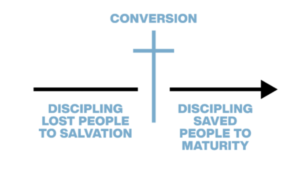
The difference is significant. Disciple-making works best when every Christian understands their role in mission as a witness to the reconciling power of Christ. It takes seriously the command of Jesus in Matthew 28:18 to “go,” into the harvest, not simply invite people to come to church. It emphasizes “make disciples of all nations,” expanding our harvesting efforts beyond people who look, talk, and think like us. It suggests that we are part of a community who are empowered to expand it. In addition to outreach, we expand the community by “baptizing” new believers “in the name of the Father and of the Son and of the Holy Spirit.” It also expects us to be part of a learning community, where we’re learning, and passing along what we learn in the context of accountable relationships so that we can teach new believers “to obey everything” Jesus has “commanded.”
For the disciple-making process described in Matthew 28:18-20 to happen, ideally Christians should have a personal experience of disciple-making, where practices are modelled and they are assisted in going into the harvest to find a person of peace and make new disciples who share deep bonds of love and are able to start the process again with people in their spheres of influence. Unfortunately, in Canada, many Christians don’t have a personal experience of going into the harvest and making disciples. Neither can they point to a systematic process for this type of disciple-making. Discipleship.org points out that fewer that 5% of churches in the U.S. have a plan for making disciples who make disciples. I imagine that the number is similar in Canada.
So, what do we do if we want to move into disciple-making? I’ve got four thoughts that seem a bit random.
First, an awakening is already happening, led by the Holy Spirit. People are embracing a return to a biblically based model of disciple-making. All over Canada we’re encountering people who are trying to shift to a highly personal, and transferable model of evangelism and discipleship. This means that they empower everyone to use simple tools, practices, and rhythms to get into their community and bring their neighbours the gospel in word, deed, and power. Novo Canada is among these ministries. (Feel welcome to get in touch for more information.)
Second, we need to acknowledge our deep need for the Holy Spirit. When the Holy Spirit came the disciples were filled with power and their ministry transformed. Why should we expect that in our own strength we could achieve different results? We’re more likely to be overwhelmed with busyness instead of seeing people’s lives transformed. E. Stanley Jones, talking about this in his book The Christ of Every Road from 1930, “…we have added a new wheel- a new committee or commission, a new plan or programme, and in the end we have found that we have added one more wheel, but with little or no power to run the old or the new. We become busy- devastatingly busy – turning old and new wheels by hand-power, by sheer hand-power instead of lighting central fires. So much of this is forced, nerve-wearing, instead of spontaneous and healing. Pentecost is not a living fact with us. Hence we worship machinery instead of winning men.” (P25) With Pentecost just around the corner let’s pursue being filled with the Holy Spirit, passionately.
Third, we need to explore the practical implications of what it means to enter Christ’s “Sabbath rest” (Hebrews 4:9). Often Sabbath rest is spiritualized to suggest a rest from works and taking hold of salvation by faith. But, what if it’s more. The stories that are brought together to make the point of Sabbath rest in Hebrews 3 and 4 describe Israel as people who refuse God’s rest as it relates to their relationship with God, but also as it relates to God’s sufficiency for all of their needs. What if one of the best ways that we can live counter-cultural lives and oppose the idols of consumerism, individualism, and selfishness is by entering God’s Sabbath rest every moment of every day of the year.
Fourth, we need to rethink our paradigm of mission at two levels. At the micro, or personal level, we need to explore what it means to be “sent” by Jesus. Does every Christian have a missional call? How do we live that out?
At the macro level or local church/denominational level we need to consider the importance of the missionary (apostolic) band or team in advancing the gospel. There’s a long story about how we came to believe that mission agencies and missionaries belong overseas doing cross-cultural work and local churches are meant to share the gospel on the “homeside.” This perspective is too limiting in our multi-cultural pluralistic culture in Canada. Our view of the body of Christ needs to be more dynamic. According to missiologist Ralph Winter the local church is only one expression of the body of Christ, which he described as a modality. The other expression he called a sodality, or missionary band. (See more here) Both are thoroughly Church.
Paul’s teams are examples of sodalities at work. They have different commitments than a local church and are often more agile and mission driven. Notably, modality and sodality have different forms (institutional structure) that are better suited to different gifts in the body of Christ. For instance, Christians who embody the apostle and evangelist types are probably more at home breaking new ground in a sodality. Those who have stronger giftings as a pastor, teacher, or prophet are probably more at home in a modalic expression of the church. (Note: You can certainly find all the gifts scattered through both expressions, but the concentration is different.)
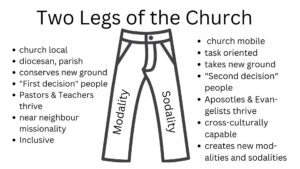
The important takeaway is that Canada needs both expressions, modality and sodality – two expressions of the body of Christ working in synergy with one another for the gospelling of the country. One breaking ground among the unreached in Canada, and the other building up the believers in neighbourhoods to be a permanent missional representation of the people of God.
Conclusion
Discipleship and disciple-making have become very different things. To recapture the essence of disciple-making described in Matthew 28 we need a reorientation to Jesus’ mission at a personal level and at a communal level. At a personal level we need to consider whether we believe that we have been “sent” by Jesus to make disciples, and if so, how are we going to do that? At a corporate level we need to consider how the local church and missionary bands can work together. At all levels we need to continually be refreshed and empowered by the Holy Spirit for a mission that we cannot possibly accomplish in our own strength.